Article
Shilajit Side Effects and Risks: What the Science Really Says
Let us be honest: if you are searching for "shilajit side effects", it is not out of idle curiosity. Something put you off. A video calling…


Shilajit is happily nicknamed “the black gold of the Himalayas”. The trouble is that wherever there is gold, there are fakes. Between genuine purified resins and the dubious pastes sold at knock-down prices on marketplaces, the market is a minefield. So let us be clear: choosing a good Shilajit is not about the brand or the packaging, it is about verifiable criteria. Here they are, no spin.
Four criteria make the difference. If a product ticks all four, you are holding something serious. If it dodges even one, be wary.
High-altitude Himalayan Shilajit is the benchmark, because the composition of the resin depends directly on the environment it forms in. You will find it elsewhere too (the Altai, the Caucasus, Tibet), but a clear, stated origin always beats a vague “Himalayan” with no detail.
This is the non-negotiable one. Raw Shilajit can contain heavy metals (lead, mercury, arsenic, cadmium) and micro-organisms, and independent testing has even found thallium in the majority of commercial supplements (a 2025 BMC Chemistry analysis detected it in five of six products, some processed samples carrying more than the raw material). Only serious purification, backed by analysis, guarantees a product is clean. The right question to ask a seller is not “is your Shilajit pure?” (everyone says yes) but “can I see the lab analysis for this batch?”. Independent testing also matters because active-compound levels vary wildly between products: when ConsumerLab tested Shilajit supplements, fulvic acid content ranged enormously from one brand to the next. We explain why this is the real safety issue in our guide to the side effects and risks of Shilajit.
Let us be honest: if you are searching for "shilajit side effects", it is not out of idle curiosity. Something put you off. A video calling…
Fulvic acid is the flagship active compound. A natural Shilajit usually contains somewhere between 20% and 50%. Beware the “more is always better” marketing trap: above 50% is often the sign of a synthetic addition. An honest, natural figure beats an inflated number.
Resin is the most authentic form and the easiest to judge by eye and by touch. Capsules are convenient but opaque: you have to trust the manufacturer on what is inside. For the detail on both forms, see our complete guide to Shilajit.
Shilajit is the story of a substance used for centuries in Ayurvedic medicine that became, in the space of a few months, a social-media darling. Inevitably,…
The 10-second test. A genuine, quality Shilajit dissolves in warm water without leaving a sandy residue, gives off a characteristic earthy smell, and comes from a seller who provides the lab analysis without being pushed. Three simple signals, before you even talk about price.
Plenty of people reassure themselves with “I bought it from a pharmacy, so it must be good”. The intention is sound, but the argument does not stand on its own. What guarantees the quality of a Shilajit is not where it is sold, it is the criteria above, lab analysis first. A product on a shelf with no analysis available is no better than any other. Conversely, a traced and tested resin is a traced and tested resin, wherever you buy it. Judge the product, not the shelf.
User feedback is useful, as long as you read it with a little perspective. The effects most often reported concern energy and vitality, which fits the uses best documented by research. Be wary, though, of the rave reviews that promise the earth in three days: Shilajit works as a course, over several weeks, and it does not replace the basics (sleep, food, training). An honest review talks about a gradual feeling, not a miracle.
I could see this coming, so I may as well own it: yes, we sell Shilajit, and yes, I am going to tell you about it. But that is exactly why we held ourselves to the checklist above. Our resin comes from high-altitude Himalayan deposits, it is standardised to a natural fulvic acid level, and the finished product is tested by an independent laboratory, heavy metals included. I am not asking you to take my word for it: that is the whole point of having the analysis.
A quick note on the legal side, because honesty is part of the checklist. In the UK and the US, Shilajit is sold as a food supplement, not a medicine, so no health claim about it has been officially approved and none of the above should be read as one. What we can stand behind is the quality and the traceability of the resin itself.
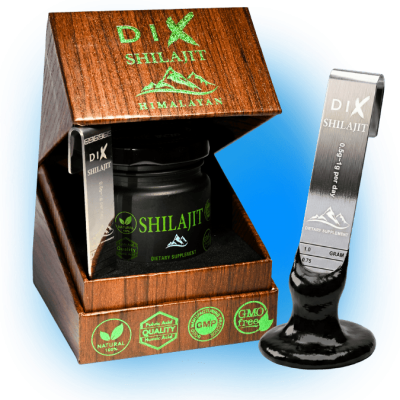
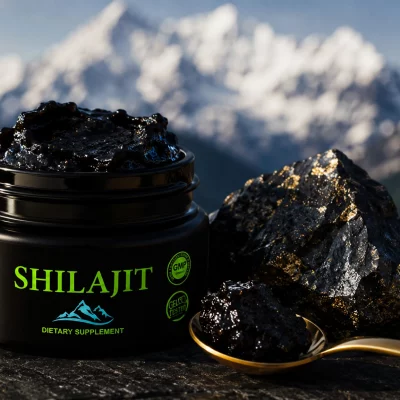
Gold Grade Purity: 100% natural Shilajit resin, harvested at 5000m altitude in the Himalayas and cold purified. Exceptional…
In stock
Once you have chosen your Shilajit, the next step is using it well: see our guide to dosage, timing and how to take Shilajit.
Are you wondering how to integrate Shilajit into your routine? When to take it to maximize its effects? What is the ideal duration of a course?…
The one that ticks four boxes: a clear high-altitude origin, available lab analysis (heavy metals included), a natural fulvic acid content (20 to 50%), and a form you can assess, such as resin.
It dissolves in warm water without a sandy residue, has a characteristic earthy smell, and the seller provides the lab analysis. A product with no analysis and no clear origin is best avoided.
Not automatically. What matters is the analysis and the origin of the product, not the point of sale.
Resin is the most authentic and the easiest to assess; capsules are more convenient to dose. The choice depends on your use.