SHIPPING FEES
Free from 70,00 € (still 70,00 €)
from
5,90 €


Are you looking for a natural and effective solution to combat aging?
Apigenin, a compound found in certain plants like chamomile, is generating growing interest in the scientific community. Let’s discover together why this flavonoid could be your new anti-aging ally.
Apigenin is a natural flavonoid, belonging to the polyphenol family, found mainly in fruits and vegetables. You can find it in notable quantities in parsley, celery, onions, chamomile, thyme, oregano, basil, as well as in certain beverages like tea, beer, and wine.
If you wish to delve deeper into the subject of apigenin, I invite you to consult our detailed article that explains in depth its molecular composition and biochemical properties.
But what particularly interests us today is its anti-aging potential…
Apigenin combats aging primarily by increasing NAD+ levels in our body, an essential molecule that naturally decreases with age.
This action is complemented by powerful anti-inflammatory and antioxidant effects that together help slow down the aging process.
You might be wondering what NAD+ is? It’s a molecule (nicotinamide adenine dinucleotide) that plays a crucial role in our cells’ energy production. Imagine it as a rechargeable battery that powers your cells! Unfortunately, with age, our NAD+ levels drop significantly, affecting our energy and vitality.
Apigenin would help maintain these levels by inhibiting an enzyme called CD38, which usually consumes NAD+. At the mitochondrial level (the powerhouses of our cells), apigenin does a remarkable job. Not only does it improve their function, but it also helps protect them from age-related damage.
Chronic inflammation and oxidative stress are two other aspects of aging that apigenin already effectively combats. It acts like a firefighter extinguishing small inflammation fires in your body while neutralizing free radicals that can damage your cells.
Let’s see what scientific studies tell us…

Research on apigenin shows particularly promising results in animal studies, especially regarding longevity and age-related diseases. However, there is currently a caveat, as clinical studies in humans remain limited, although the initial results are encouraging.
Researchers have conducted fascinating studies on different animal models. For example, in C. elegans worms (a commonly used research organism), administration of apigenin at a concentration of 200-400 μg/mL significantly increased their lifespan.
It also improved their resistance to oxidative stress (something already known for Apigenin) by regulating the expression of several important aging-related genes.
In mice, the results are equally interesting. A study showed that apigenin, administered orally at 300-900 mg/kg, improved learning and memory in aged mice. Researchers also observed protection against oxidative damage and improved cerebral blood flow.
On the clinical studies side, research primarily uses chamomile extract, which contains about 5% to 25% apigenin.
An eight-week study using 500 mg of extract three times a day showed significant improvements in anxiety and blood pressure in elderly participants. Other studies, however, have highlighted the role of apigenin in sleep, on the heart, and in fighting oxidative stress. Sleep being an important factor for health, good sleep will improve your quality of life, and thus your way of aging.
Research has the advantage of answering some questions but also sometimes raises others. Here are the questions you most often ask about apigenin and anti-aging.
Apigenin and NMN act differently on aging, and it would be inaccurate to say that one is better than the other. Clinical studies on NMN are more numerous and standardized, while apigenin has the advantage of being more natural and accessible in the diet.
NMN acts directly as a precursor of NAD+, with clinical studies showing significant increases in blood NAD+ levels (up to 2.5 times) after supplementation. Apigenin, on the other hand, acts indirectly by inhibiting CD38, which helps preserve existing NAD+ levels.
Clinical studies on NMN are more advanced, with well-established dosages (250-500 mg/day) and promising results on muscle strength and metabolism. In contrast, apigenin shines for its versatility: it combines its effects on NAD+ with anti-inflammatory and antioxidant properties that NMN does not possess.
Yes, and it is even highly recommended!
Apigenin works particularly well in synergy with other natural compounds. Research shows that its combination with quercetin and resveratrol creates a particularly powerful anti-aging effect.
Quercetin, found in red onions and apples, shares a similar chemical structure to apigenin, except for two additional hydroxyl groups.
This similarity allows them to work in tandem to amplify their antioxidant effects. As for resveratrol, found notably in red grapes and wine, it perfectly complements the action of apigenin by targeting complementary cellular signaling pathways.
Other interesting combinations include vitamin C, which helps recycle flavonoids like apigenin, and omega-3 fatty acids, which can enhance its absorption. (A traditional Mediterranean diet naturally combines these elements).
Studies suggest that a daily intake of 50 to 100 mg of apigenin would be beneficial. (This dose can be achieved through a diet rich in aromatic herbs and vegetables)
Available studies show an excellent safety profile, notably through the consumption of foods rich in apigenin. However, as an isolated supplement, the very long-term effects remain to be studied.
Prioritize natural food sources and combine them with a healthy lifestyle: quality sleep, regular exercise, and stress management. (Apigenin is better absorbed with a meal containing healthy fats)

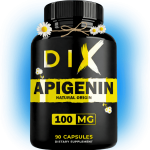
Scientific studies, notably on neurovascular coupling (see the study), demonstrate the remarkable effectiveness of apigenin in combating cellular aging. This in-depth research reveals how apigenin actively protects our brain cells – it is precisely for these exceptional anti-aging properties that we have developed our unique formula, which perfectly combines with our NMN to maximize NAD+ production and amplify anti-aging effects.
Our chamomile extract stands out for its exclusive flower extraction process, where apigenin reaches its maximum natural concentration. This approach, unlike products using synthetic apigenin or whole plant extracts, preserves the natural synergy of bioactive compounds. (The flowers contain up to 1.2% natural apigenin in their most bioavailable form)
The anti-aging effectiveness of our product relies on multiple mechanisms of action: apigenin preserves your NAD+ levels by inhibiting CD38, while our NMN increases them directly. This dual action, combined with fighting oxidative stress and chronic inflammation, creates a powerful synergy against aging. More remarkably, our natural apigenin acts in perfect complementarity with NMN to optimize your cellular defenses.
For optimal anti-aging effect, our formula integrates perfectly into your daily routine. (Recommendation: 1-2 capsules of apigenin per day with your NMN during the meal). By choosing our apigenin-NMN duo, you opt for a natural and complete solution, whose anti-aging effectiveness is validated by science, to sustainably preserve your youth.