SHIPPING FEES
Free from 70,00 € (still 70,00 €)
from
5,90 €


Let us be honest for two minutes: few plants carry as many promises and as many fears at the same time as Tribulus terrestris. On one side it is credited with the power to transform your testosterone; on the other, people type “tribulus side effects” into Google at two in the morning, wondering whether they have just made a mistake. The truth, as so often, is calmer than either extreme.
Tribulus is a textbook case: a real active compound, real properties that are often misunderstood, and risks that do exist provided you look at the right ones. Let us calmly sort out together what deserves your attention from what belongs mostly to gym legend.
Tribulus terrestris is a perennial plant used for centuries in Ayurvedic and traditional Chinese medicine. What interests us is not its spines but its chemistry: the plant is rich in steroidal saponins and, in particular, in protodioscin, the molecule to which most of its effects are attributed. It is what you measure when you talk about the quality of an extract.
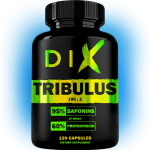
And that is where everything is decided. The make-up of a tribulus varies enormously with its geographical origin and the part used (fruit, leaves or roots). Most extracts on the market are standardised to total saponins, a flattering but largely meaningless figure, whereas it is the protodioscin content that actually does the work. That is precisely why, at DIX, we select an extract standardised to 95% saponins of which 60% protodioscin, rather than a vague powder titrated blind.
This is THE question, and I will be direct with you, because this is where most sellers take you for a fool. In young, healthy men, serious studies show no significant increase in testosterone. One of the most cited studies on the subject, conducted in young men, concludes in black and white that tribulus does not influence androgen production (Neychev & Mitev, 2005). More recent work goes the same way: a 2025 systematic review of clinical trials (Nutrients) found no robust evidence for raising testosterone, with eight of ten studies reporting no significant change in the androgen profile. The classic review by Qureshi, Naughton and Petróczi (Journal of Dietary Supplements, 2014) had already concluded that the marketing claims are unsubstantiated. And at European level, no health claim for tribulus is authorised, so no one can legally promise you a hormonal effect.
So where does this stubborn reputation come from? Because tribulus acts elsewhere. The available data point to a more credible effect on libido and sexual function, probably through a mechanism independent of testosterone itself. In other words: feeling a rise in desire does not mean your hormone level has gone up. It is a nuance the labels conveniently forget, and exactly the kind of honesty that stops you spending for the wrong reasons.

Let us get to the point, because it is probably what brought you here. First the good news: at sensible doses, tribulus is generally well tolerated. The most common side effects are digestive (cramps, bloating, reflux), mostly on an empty stomach, and usually disappear when the extract is taken with a meal.
Now let us talk about the real points of caution, the ones too often left unsaid. The NIH LiverTox database records rare but serious cases of liver injury after tribulus use, sometimes at high doses or with poorly traced products, and animal studies describe toxicity affecting the liver and kidneys, the very organs that metabolise and clear the active compounds. The same plant contains β-carboline alkaloids (harman, norharman) that the EFSA compendium of botanicals classes among substances “of possible concern”. The point is not to frighten, but to dose caution with real data.
The most important point in practice, though, is contamination. Undeclared anabolic or androgenic steroids have repeatedly been detected in tribulus products, and analytical studies have found protodioscin below the limit of quantification in some supplements, meaning the real content does not match the label. In plain terms: the biggest risk does not come from the plant, but from an opaque product. The origin and traceability of your extract are not a marketing detail, they are your first line of safety, and this kind of contamination is exactly why quality control matters. The famous gynaecomastia people sometimes wave around is, at usual doses, more a myth than a demonstrated risk, since the plant does not raise the testosterone that could aromatise.
There are situations where, out of plain common sense, you abstain or ask for medical advice:
As you can see, “tribulus danger” is almost never the plant on its own. It is the dubious product, the excessive dose or a particular health background. A clean, well-dosed extract, taken by a healthy person, remains one of the best-tolerated supplements in its category.
This is a frequent question, and the honest answer is reassuring with one caveat. In the United States, tribulus is sold legally as a dietary supplement under the DSHEA framework: it is not pre-approved by the FDA for safety or efficacy, its label may carry structure/function statements (such as “supports vitality”) but never a disease claim, and it must bear the disclaimer that the statement “has not been evaluated by the Food and Drug Administration”. In the UK and the EU it is likewise sold freely as a food supplement. The plant itself is not a banned doping substance: the US Department of Defense supplement-safety programme (OPSS) notes that tribulus is not on its prohibited-ingredients list and should not cause a positive on a routine drug test.
The caveat is contamination, not the plant. Because undeclared steroids have been found in some products, OPSS advises athletes and service members to choose supplements that carry a third-party certification seal. That is the whole point of a traceable, titrated extract: “legal” is not the same as “safe to buy blind”.
The dose generally cited sits between 500 and 1500 mg a day, ideally split into two intakes with meals. But the raw figure means nothing without context: 1000 mg of an extract titrated to 95% saponins is nothing like 1000 mg of a standard powder. That is the whole logic of a concentrated extract at a 100:1 ratio, where you are after richness in actives rather than weight on the label. The details on courses and cycles are covered in our tribulus dosage and usage guide.
Our daily work is to pick through the studies to design honest formulas. It is in that spirit that we selected our DIX Tribulus terrestris, where the market too often settles for the bare minimum.
You could see it coming, so let us own it: yes, we have our own tribulus. But look precisely at what sets it apart, because it is the direct answer to everything we have just seen. While most extracts are titrated to total saponins (the easy figure), ours is standardised to 95% saponins of which 60% protodioscin, the active that really counts, in an ultra-concentrated capsule at a 100:1 ratio.
Very high concentration: Purified Tribulus Terrestris extract (Ratio 100:1) with the highest Protodioscin rate in Europe Power &…
In stock
And, as always, the same honesty to finish: no tribulus will replace regular training, real sleep and a coherent diet. It comes on top of those foundations, never in their place. Keep realistic expectations and you will get the best from it without ever flirting with the slightest danger.
This article focuses on the risks. For the rest of the subject we have published dedicated guides: the complete tribulus terrestris guide (the overview), the truth about tribulus, testosterone and bodybuilding, and the dosage and usage to get it right.
Frequently asked questions about tribulus dangers and side effects
There is no generally fixed toxic threshold, but very high doses and poorly traceable products are associated with the rare reported incidents. The usual amounts (around 1 or 2 capsules of a concentrated extract) stay in the well-tolerated range.
The plant itself is not a banned substance and is not on the WADA prohibited list. The risk comes from contamination: undeclared anabolic steroids have been detected in some tribulus products, which could disturb a test. A traceable, third-party-tested extract is decisive here.
Only after checking with your doctor. Tribulus may influence cardiovascular and blood-sugar-lowering effects; with an ongoing treatment, the combination should not be made without advice.
At usual doses it is not demonstrated. Because tribulus does not reliably raise testosterone, the mechanism that would trigger aromatisation, and with it gynaecomastia, is missing.
By a standardisation in protodioscin (not just total saponins), a clear origin and a stated plant part, a guarantee free of mycotoxins and an identifiable manufacturer. Opaque products, titrated only to total saponins, are the real risk.
Yes, it is the most common side effect and it is usually mild and passing. Taking the extract with a meal, rather than on an empty stomach, almost always resolves it.