

SHIPPING FEES
Free from 70,00 € (still 70,00 €)
from
5,90 €


Tribulus terrestris carries a very masculine image, tied to the gym and to testosterone. That is reductive, and even paradoxical: it may be in women that some of the data are most interesting. This article takes stock, without overstating the promises, of what tribulus can bring to women and the precautions to know.

Libido and vitality are not a men’s affair. Yet the most credible interest of tribulus lies precisely in libido and sexual function, a field that concerns women just as much. In them too, tribulus does not behave like a hormone: it is not meant to “masculinise” anything, a common but unfounded fear at usual doses, since the plant does not raise testosterone.
Several studies have looked at female libido, particularly in periods when desire can drop, such as the menopause or after certain phases of fatigue. A systematic review of tribulus for female sexual dysfunction found some studies reporting improved desire and satisfaction, but rated the certainty of the evidence as very low. The signal is encouraging while remaining to be confirmed: we are talking about a serious lead, not a certainty. Caution therefore stays in the wording, even if the signal is rather favourable.
What can and cannot be said
The research suggests a possible support for desire in women, particularly during dips linked to fatigue or the menopause. It is neither a hormone treatment nor an answer to a medical disorder. In case of persistent discomfort, medical advice remains the right step.
This is the most widespread fear, and the easiest to lift. Such effects would be linked to a rise in androgens. But, as in men, tribulus does not raise testosterone in any demonstrated way. The dreaded mechanism therefore has no solid basis at recommended doses. That does not remove the need for common sense: respect the doses and take the contraindications below into account.
The fear of masculinisation is the first reason women give it up. But it rests on a mechanism that tribulus does not trigger. The rundown, without playing down the real precautions.
The real precaution is not masculinisation, but pregnancy, breastfeeding and hormone-dependent tumours.
These precautions are detailed in our article on the real dangers and side effects of tribulus.

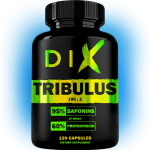
The quality criteria are the same as for men: what counts is protodioscin, not the total-saponin figure on show. Our DIX Tribulus terrestris is a fruit extract titrated to 95% saponins of which 60% protodioscin, 100:1 ratio, free of mycotoxins, made in France. As for use, 1 to 2 capsules a day in the morning with a meal, over several weeks to judge a background effect.
Very high concentration: Purified Tribulus Terrestris extract (Ratio 100:1) with the highest Protodioscin rate in Europe Power &…
In stock
For the male angle of the subject, see tribulus and libido in men, and for the overall picture, the complete tribulus terrestris guide.
Tribulus for women: your questions
It is one of the periods studied for libido. In the absence of a contraindication and outside hormone-dependent cancer, it can be considered, ideally with medical advice.
No interaction is clearly established, but tribulus has not been studied in this precise context. As a precaution, talk to your doctor or pharmacist before combining the two, all the more so as the aim here is precisely hormonal balance.
There is no proof of a gain in strength or muscle mass attributable to tribulus, in women as in men. For a sportswoman, its possible interest stays on the side of perceived vitality and libido, not performance as such.
Think in weeks, not days: several weeks of regular intake are needed to judge a background effect. Taking it as a course, with breaks, is a reasonable approach; strict, complicated cycling has no solid justification.
Vous devez etre connecte pour laisser un commentaire.