SHIPPING FEES
Free from 70,00 € (still 70,00 €)
from
5,90 €


Apigenin, a natural molecule found in chamomile, could improve your sleep. In this article, we will review scientific studies, dosage, and proven effects for better rest thanks to this natural compound.
Apigenin is a natural compound belonging to the flavonoid family, molecules abundant in the plant kingdom. Present in many everyday foods, it is gaining interest for its potential effects on sleep.
Moreover, you are probably already consuming apigenin without knowing it! This molecule is hidden in many foods in your kitchen, particularly in herbs like parsley, thyme, oregano, and basil. For tea lovers, you will find it in significant amounts in chamomile (about 1% of dry mass). Fruits like grapefruit and orange, as well as certain drinks like beer and wine, also contain it.
Studies have therefore focused on apigenin and sleep, here’s what they reveal.
Apigenin affects our sleep through several complex but well-identified biological mechanisms. Its main action is through interaction with GABA receptors (the brain’s main inhibitory neurotransmitter) and the regulation of various sleep-related biological markers.
It interacts differently than traditional sleeping pills. What’s particularly interesting is that it does so independently of benzodiazepine receptors, suggesting a potentially more favorable side effect profile (less risk of dependency).
Another fascinating aspect of apigenin is its action on oxidative stress and inflammation. You probably know that stress and inflammation can disrupt your sleep? Apigenin helps reduce these disruptors by decreasing the production of inflammatory molecules like TNF-α and IL-6.
But that’s not all! Apigenin also influences crucial biological markers for sleep. It notably increases levels of BDNF (a brain growth factor) and serotonin (a precursor of melatonin, the sleep hormone). These changes contribute to creating more favorable conditions for quality sleep.

Research on apigenin and sleep shows promising results, although it’s important to distinguish studies on pure apigenin from those using chamomile extract.
In the field of animal studies, the work of Chow et al. (2011) is particularly enlightening. Their team used telemetry methodology to measure the sedative effects of apigenin in mice. By administering a dose of apigenin orally, they observed a significant reduction in locomotor activity within 90-120 minutes following administration.
A major clinical study was conducted by Zick et al. (2011). This research, conducted on patients suffering from primary chronic insomnia, used a rigorous protocol: 540 mg of chamomile extract per day (equivalent to about 5.4 mg of apigenin), divided into two doses over 28 days.
The results showed an improvement in daytime functioning, even though the results did not reach statistical significance.
More recently, Godos et al. (2020) conducted a significant cross-sectional study on a cohort of Italian adults. This research established for the first time a direct correlation between dietary apigenin intake and sleep quality. Interestingly, people with higher apigenin intake in their diet reported better sleep quality.
Chang and Chen (2016) provided particular insight with their randomized controlled trial on postpartum women. Using chamomile tea for two weeks, they observed significant improvements not only in sleep quality but also in postpartum depression symptoms.
These studies show us that research on apigenin follows two main paths: the study of the pure molecule and that of natural extracts containing it. The results suggest a gradual rather than immediate efficacy, with benefits that seem to accumulate with regular use.
No, apigenin is not a sleeping pill in the classical sense. It is rather a natural compound that gently promotes sleep without causing the characteristic effects of traditional sleeping pills.
Unlike traditional sleeping pills that can create dependency and have significant side effects, apigenin acts more subtly on your body. It doesn’t “force” sleep but rather helps your body regain its natural rhythm, notably by reducing anxiety and oxidative stress. In fact, studies suggest that apigenin is also good for the heart.
Studies show that apigenin produces a mild sedative effect, quite different from the debilitating drowsiness that some medications can cause. In fact, it promotes more of a state of calm and relaxation than true drowsiness.
The ideal time to consume foods rich in apigenin or supplements would be in the early evening (about 2-3 hours before bedtime), allowing your body to fully benefit during your sleep cycle.
Most clinical studies have used chamomile extracts containing about 270 mg twice a day, with less than 50mg of Apigenin per dose.

Current research does not provide direct data on the impact of apigenin on dreams. However, its effect on serotonin levels and brain activity suggests it could influence sleep phases, particularly REM sleep where most dreams occur.
Long-term studies on apigenin are reassuring in this regard. Unlike many sleep-affecting substances, apigenin does not seem to induce tolerance. This is due to its mode of action which does not disrupt the natural sleep mechanisms but supports them through various metabolic pathways (notably through its action on oxidative stress and inflammation).
The bioavailability of apigenin varies according to its form. Studies have shown that when compounds like apigenin are isolated from their natural source, their bioavailability can be compromised. This means the body may have more difficulty absorbing and fully benefiting from them.
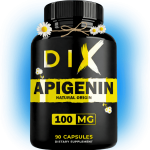
However, in our case, the apigenin we offer comes directly from a chamomile extract, which provides better bioavailability.
When kept in its natural environment, apigenin is accompanied by cofactors and bioactive components that work synergistically to facilitate its absorption by the body.
In other words, the chamomile extract allows apigenin to be better assimilated and more effective compared to an isolated form. This ensures not only optimal absorption but also that you get the most out of the soothing and relaxing benefits of apigenin.
By choosing our chamomile-extracted apigenin, you opt for a more natural and bioavailable form, making it a superior solution.
Let’s now draw conclusions from everything we’ve learned about apigenin and sleep.
Science confirms it: apigenin is not just a simple natural compound, but a true ally for our sleep. The scientific studies presented in our article demonstrate its effectiveness through several well-identified mechanisms of action, notably its interaction with GABA receptors and its impact on biological markers of sleep.
What makes our chamomile extract particularly interesting is that it is obtained exclusively from the flowers, where apigenin naturally concentrates. Unlike synthetic products or extracts using the whole plant, our approach respects the natural synergy of the compounds present in the chamomile flower. The clinical studies cited earlier, notably the one using 270 mg of chamomile extract twice a day, confirm the relevance of this approach.
The major advantage of our extract lies in its gentle yet effective action. As research on the absence of tolerance and dependence shows, you can use it confidently in the long term, without fearing the side effects often associated with conventional sleeping pills. Moreover, the natural bioavailability of apigenin in the chamomile flower ensures optimal absorption by your body.
By choosing to purchase our naturally sourced apigenin, you opt for a scientifically validated solution, respectful of your physiology, and perfectly aligned with a holistic approach to sleep.