Article
How to Recognise the Best Shilajit: A Purity and Quality Guide
Faced with the variety of Shilajit on the market, how can you be sure to choose the best?


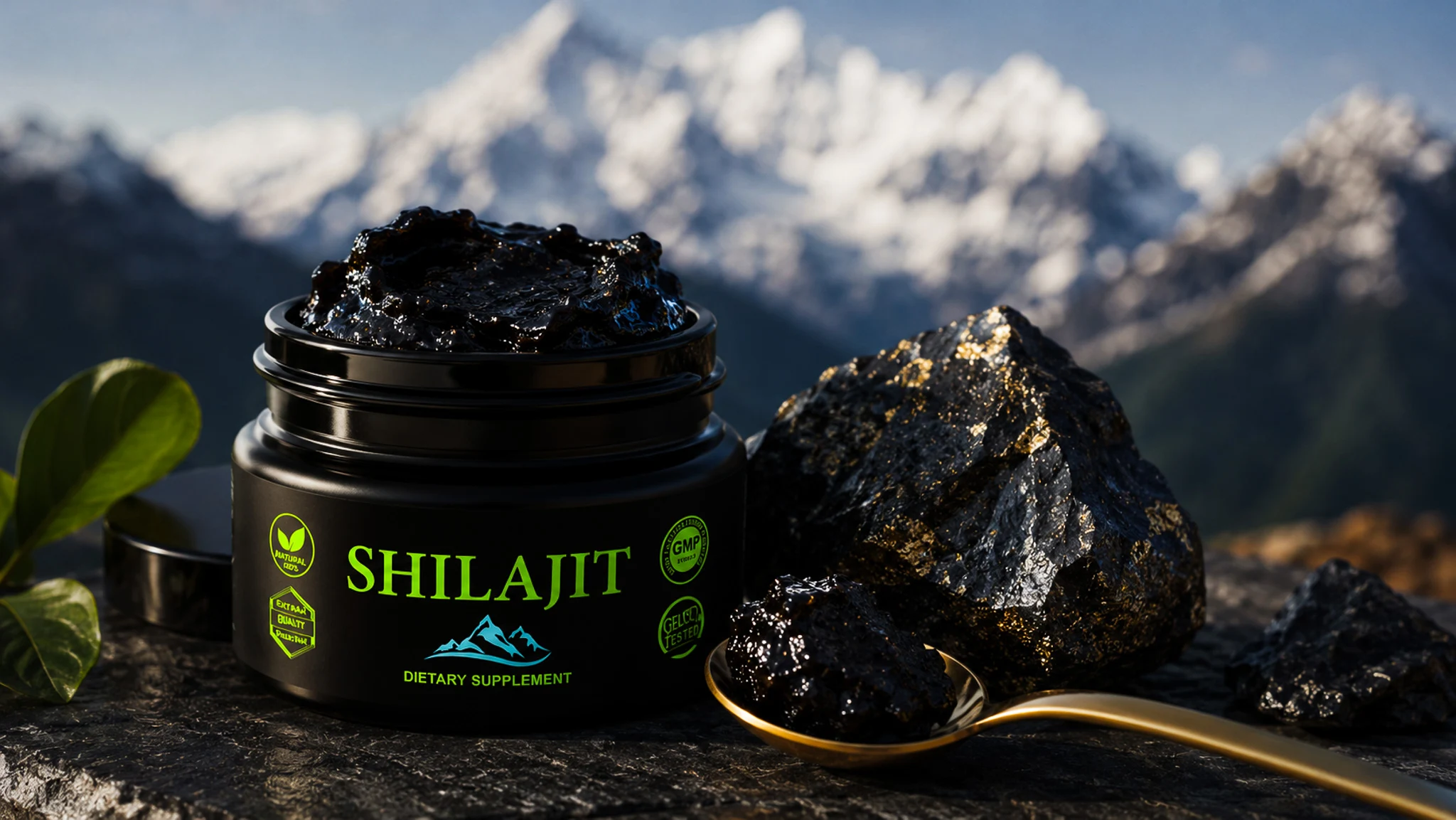
Let us be honest: if you are searching for “shilajit side effects”, it is not out of idle curiosity. Something put you off. A video calling it a scam, a sceptical friend, or that simple healthy reflex when you are about to swallow a black resin from the Himalayas: “hang on, is this stuff actually safe?”
Good question. And the honest answer fits in one sentence: the danger of Shilajit almost never comes from the Shilajit itself, but from its quality. A pure, properly purified Shilajit is well tolerated by the vast majority of people. A low-grade, untested Shilajit bought at random on a marketplace is another story entirely. Let us look at both honestly, with the studies to back it up, and without overselling you anything.
Let us start with the substance. On the available human and animal data, purified Shilajit shows no notable toxicity at usual doses. A pilot study published in 2026 followed 25 men taking 500 mg of Shilajit resin per day for 28 days: no serious adverse events reported, and the safety markers (liver, kidney, blood parameters) stayed within normal ranges.
Let us stay measured: that study is small, has no placebo group, and 28 days is short. It is not definitive proof of long-term safety, and I am not going to pretend otherwise. But it points the same way as the rest of the literature: at reasonable doses, on a clean product, Shilajit raises no particular alarm.
The important word in that sentence is “clean”. And that is where the real issue hides.
When they occur, the reported side effects are generally mild and temporary:
Nothing dramatic for most people. The common-sense rule: start with a small dose, watch how you react, and do not confuse “more” with “better”. Shilajit is not something you take by the spoonful.
This is the heart of the matter. Raw Shilajit, straight out of the rock, is not ready to be consumed. In its natural state it can contain mycotoxins, fungi, pollutants and above all heavy metals (lead, arsenic, cadmium, mercury) accumulated in the material over centuries. Independent testing has even found thallium, one of the more toxic heavy metals, in commercial Shilajit: a 2025 analysis in BMC Chemistry detected it in five of six supplements tested, with some processed products carrying more than the raw material. This is exactly why a serious Shilajit goes through a purification step, and then through laboratory analysis.
The problem is that this testing costs money. As a result, a large share of the Shilajit sold online, often at cut prices, is neither properly purified nor tested. Independent analyses of market samples have repeatedly found heavy-metal levels above recommended thresholds. That is the real danger of Shilajit. Not the resin itself: the lack of control.
To put numbers on it, here are the maximum heavy-metal levels allowed for a food supplement under EU regulation (a useful benchmark, since we ship across Europe). A serious Shilajit should sit well below these.
| Heavy metal | Maximum level (food supplement) |
|---|---|
| Lead (Pb) | 3.0 mg/kg |
| Cadmium (Cd) | 1.0 mg/kg |
| Mercury (Hg) | 0.10 mg/kg |
| Arsenic (As) | No dedicated supplement limit, so lab testing is the only guarantee |
Two points of context for other markets. In the United States, the FDA has set no heavy-metal limit for dietary supplements at all, leaving it to each maker, which is why third-party testing matters even more there. California’s Proposition 65 is far stricter on lead, flagging exposure above just 0.5 micrograms per day. And when ConsumerLab tested Shilajit supplements, it found fulvic acid content varied enormously between brands, a reminder that “Shilajit” on a label tells you very little on its own.
Here I am going to be blunt, because this is exactly the point where talk and action part ways. Everyone will tell you to “choose a pure, quality Shilajit”. Almost no one actually shows you the analysis of their own product. And yet that is the only thing that really counts.
The reflex that changes everything: before buying a Shilajit, do not ask “is it pure?” (everyone will claim so). Ask: “can I see the laboratory analysis for this product?” A serious seller provides it. The others change the subject.
This is also why you cannot lean blindly on “it is sold in a pharmacy, so it must be safe”. The argument is reassuring, but what guarantees safety is not a shop’s shelves: it is the analysis of the specific product you are buying.
Our stance at DIX. Our resin is purified, and then the finished product is tested by an independent laboratory. On those analyses, mercury and cadmium come out virtually undetectable, far below the regulatory limits. This is not one more marketing line: it is the only honest answer to the question “is it dangerous?”. A Shilajit whose purity you can verify is not in the same league as an anonymous product.
The question comes up often, so let us take it head on. There is no scientific evidence that Shilajit causes cancer. On the contrary, part of the research is interested in its antioxidant properties. The fear comes from elsewhere, and always from the same place: contamination. A Shilajit loaded with heavy metals, taken over the long term, is the kind of chronic exposure that poses a health problem, not the purified resin itself.
In other words, the right question is not “does Shilajit cause cancer?” but “has what I am about to swallow been tested?”. We always come back to the same place.
Shilajit is still a supplement, not a sweet. A few situations call for caution or medical advice:
Nothing alarming, just common sense. If in doubt medically, settle it with a healthcare professional, not with a blog article, mine included.
For more detail on this topic: How to Take Shilajit: Dosage, Timing and How Long to Use It.
If you remember only a few criteria before buying:
That is exactly the checklist we set for our own Shilajit resin: standardised pure resin, high-altitude Himalayan origin, a natural fulvic acid level, and laboratory analysis to back it up. I am not asking you to take my word for it, which is precisely the point.
For context, Shilajit is sold as a food supplement, not a medicine (under DSHEA in the US and as a food supplement by the FSA in the UK), so no health claim about it has been officially approved. What can be verified is the purity of the resin, and that is what we ask you to judge.
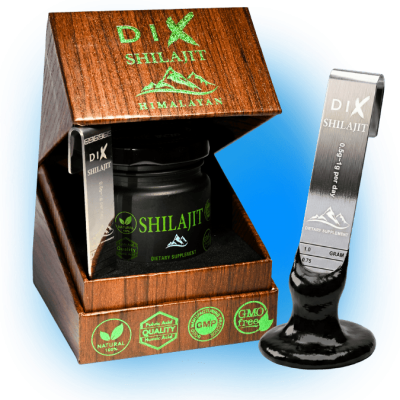
Gold Grade Purity: 100% natural Shilajit resin, harvested at 5000m altitude in the Himalayas and cold purified. Exceptional…
In stock
To go further, see also: how to recognise a pure, reliable Shilajit and the complete guide to Shilajit.
Faced with the variety of Shilajit on the market, how can you be sure to choose the best?
Shilajit is the story of a substance used for centuries in Ayurvedic medicine that became, in the space of a few months, a social-media darling. Inevitably,…
On a purified, tested product, the available studies show no liver or kidney harm at usual doses. The risk comes from a contaminated product, not the clean resin.
Yes, that is the common use, as a course, at a reasonable dose (often around 250 to 500 mg per day depending on the product). Avoid overdosing.
No hypertensive effect has been established. If you have treated high blood pressure, ask your doctor as a precaution.
Not automatically. What guarantees safety is the analysis of the product, not the point of sale.

Vous devez etre connecte pour laisser un commentaire.